
Quick answer: Medical coding software helps coders assign ICD-10, CPT, and HCPCS codes, check them against payer edits, and send clean claims. Tools differ in specialty code sets, EHR and clearinghouse integrations, automation, and price. The right choice depends on practice size, specialty mix, and whether coding is handled in-house or outsourced.
In today’s healthcare world, medical coding software has become a must-have for professionals and billing teams. These tools help make coding tasks faster, reduce errors, and improve accuracy. In this blog, we’ll explore the top 10 best medical coding software solutions transforming healthcare in 2026.
What is Medical Coding Software?
Medical coding software is a tool that helps assign codes to medical diagnoses and procedures. It protects patient privacy by not revealing personal details. While it can’t replace human medical coders, it makes their job easier and faster. This software reduces workload and improves productivity with just a few clicks.
Top 10 Medical Coding Solutions
The popularity and performance of software can change over time. It’s always a good idea to check the latest reviews and features before choosing one. Here are ten medical billing software options, which are worth exploring.
1. Dilijent Systems
Dilijent Systems is a top choice for medical office solutions, trusted by many healthcare businesses. Our platform offers a wide range of features. It is designed to fit practices of all sizes, from solo doctors to large groups with over 100 physicians.
Our solution is flexible—you can use just the billing software or expand to a full practice management system. Since it’s cloud-based, you can securely access patient data from anywhere on any device.
Here’s what makes our software stand out:
-
Easy scheduling for multiple locations, providers, and specialties
-
Real-time dashboards to track billing performance
-
Strong security settings to control data access
-
Patient engagement tools like CRM and social media management
-
A dedicated team that helps you get paid right
2. 3M Codefinder
3M Codefinder is one of the top medical coding software solutions. It provides accurate coding for ICD-10, CPT, and HCPCS codes. This powerful tool increases efficiency, reduces errors, and helps healthcare professionals stay updated with the latest coding guidelines.
3. Optum360 EncoderPro
Optum360 EncoderPro is a cloud-based coding software with a simple, user-friendly design. It makes coding easier, offers real-time updates, and works well with electronic health record (EHR) systems. It’s a great choice for any medical practice looking to improve efficiency.
4. WebPT
WebPT is a popular EMR system used in outpatient physical therapy. Known for its feature-rich clinical charting, it is the top choice for rehab therapy organizations. For larger practices, WebPT billing connects front and back-office workflows. This all-in-one system saves time and helps increase profits.
5. CollaborateMD
CollaborateMD is a cloud-based practice management and medical billing system. It simplifies workflows by making appointment scheduling and claim management easy. Their system also offers detailed analytics and reporting, making it a solid choice for practices looking to streamline their billing process.
6. Claimocity
Claimocity is a flexible billing platform designed for inpatient healthcare providers. It covers all backend functions, from capturing patient encounters to getting paid. With its new AI charge capture tool, Claimocity saves you hours by automating parts of the billing process.
7. DrChrono
DrChrono is a leader in the EHR space, offering an integrated platform with customizable EHR, practice management, medical billing, and RCM features. This system is great for practices with multiple locations. If you only need a billing system, DrChrono also offers modular options to suit your needs.
8. CareCloud
CareCloud provides cloud-based solutions for growing healthcare organizations. Their platform transforms billing processes and includes essential tools like revenue management, EHR systems, practice management, and patient experience management. CareCloud makes it easier to manage the full scope of healthcare operations.
9. Kareo
Kareo is a healthcare IT provider that offers easy-to-use software to help practices manage workflows and improve patient care. While Kareo doesn’t directly offer revenue cycle management (RCM) services, it partners with medical billing software affiliates to meet the needs of its users. Their platform also helps track claims through the payment process, making it a valuable tool for practices.
10. Medicode
Medicode is a powerful medical coding software that increases productivity and errors. With its large code library and advanced search features, it’s a great choice for healthcare facilities. This software ensures accurate and efficient coding, making it easier for practices to manage their coding needs.
How the Top Tools Compare at a Glance
The list above is long. This table pulls the ten tools into one view so you can shortlist faster. “Best fit” reflects the setting each product is built around, not a ranking.
| Tool | Built around | Cloud-based | EHR / PM integration |
|---|---|---|---|
| Dilijent Systems | Billing + full practice management | Yes | EHR & PM |
| 3M Codefinder | Coding reference | Yes | Limited |
| Optum360 EncoderPro | Coding + compliance | Yes | EHR |
| WebPT | Rehab therapy EMR | Yes | Billing + EMR |
| CollaborateMD | Practice management + billing | Yes | PM |
| Claimocity | Inpatient billing | Yes | Billing |
| DrChrono | EHR + RCM | Yes | EHR & PM |
| CareCloud | RCM + patient experience | Yes | EHR & PM |
| Kareo | Clinical + billing software | Yes | PM |
| Medicode | Coding productivity | Yes | Limited |
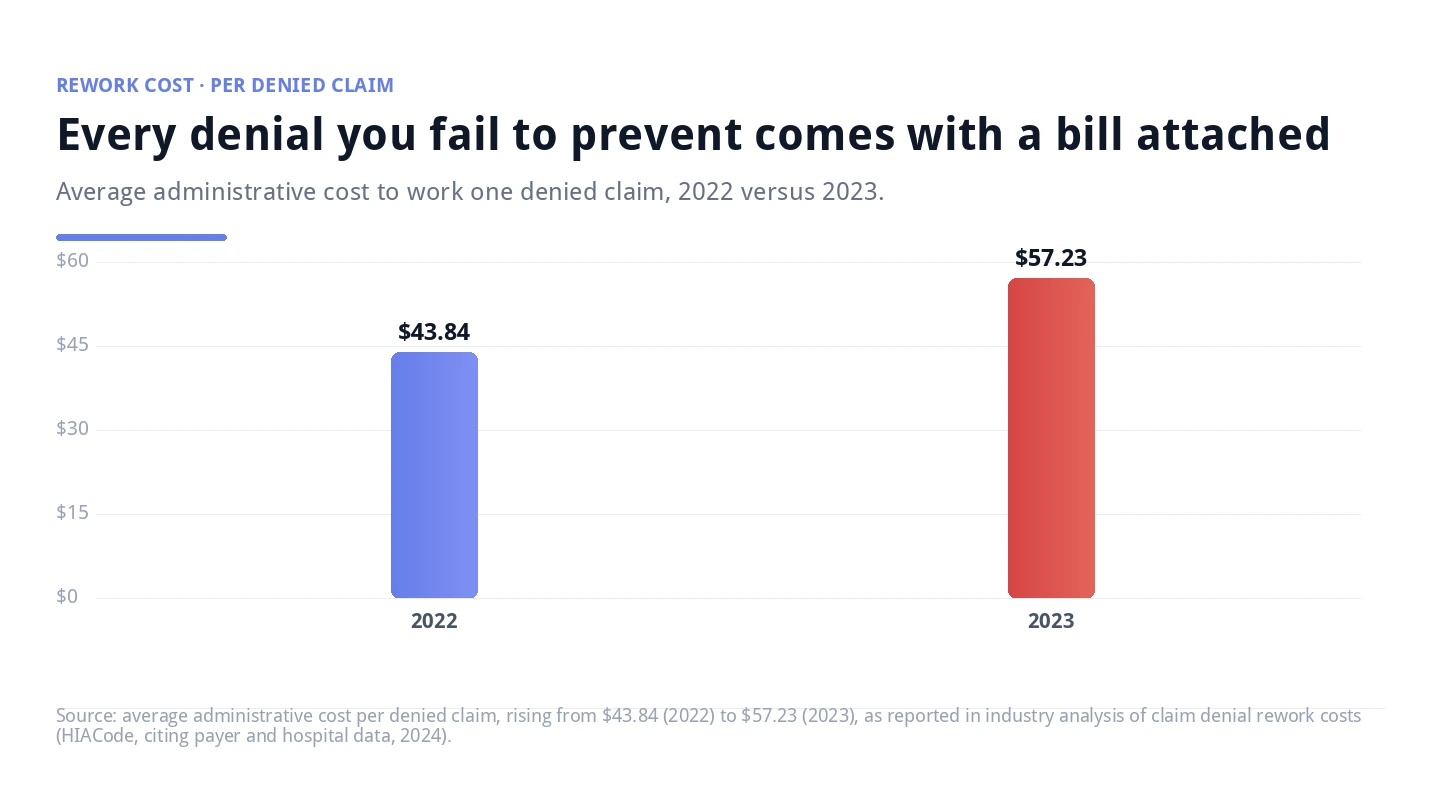
Software is only half of a clean claim. The other half is who reads the denials and works them — which is where a managed revenue cycle management partner often earns its keep.
What Are the Key Features to Look for in Medical Coding Software?
Key features to consider include:
-
Code Lookup
-
Compliance Tools
-
EHR Integration
-
AI-Powered Code Suggestions
-
Mobile Access
-
Audit Trails
-
Reporting & Analytics
-
Real-Time Error Detection
-
Patient Scheduling Integration
-
Advanced NLP & AI Features
-
Cloud-Based Solutions
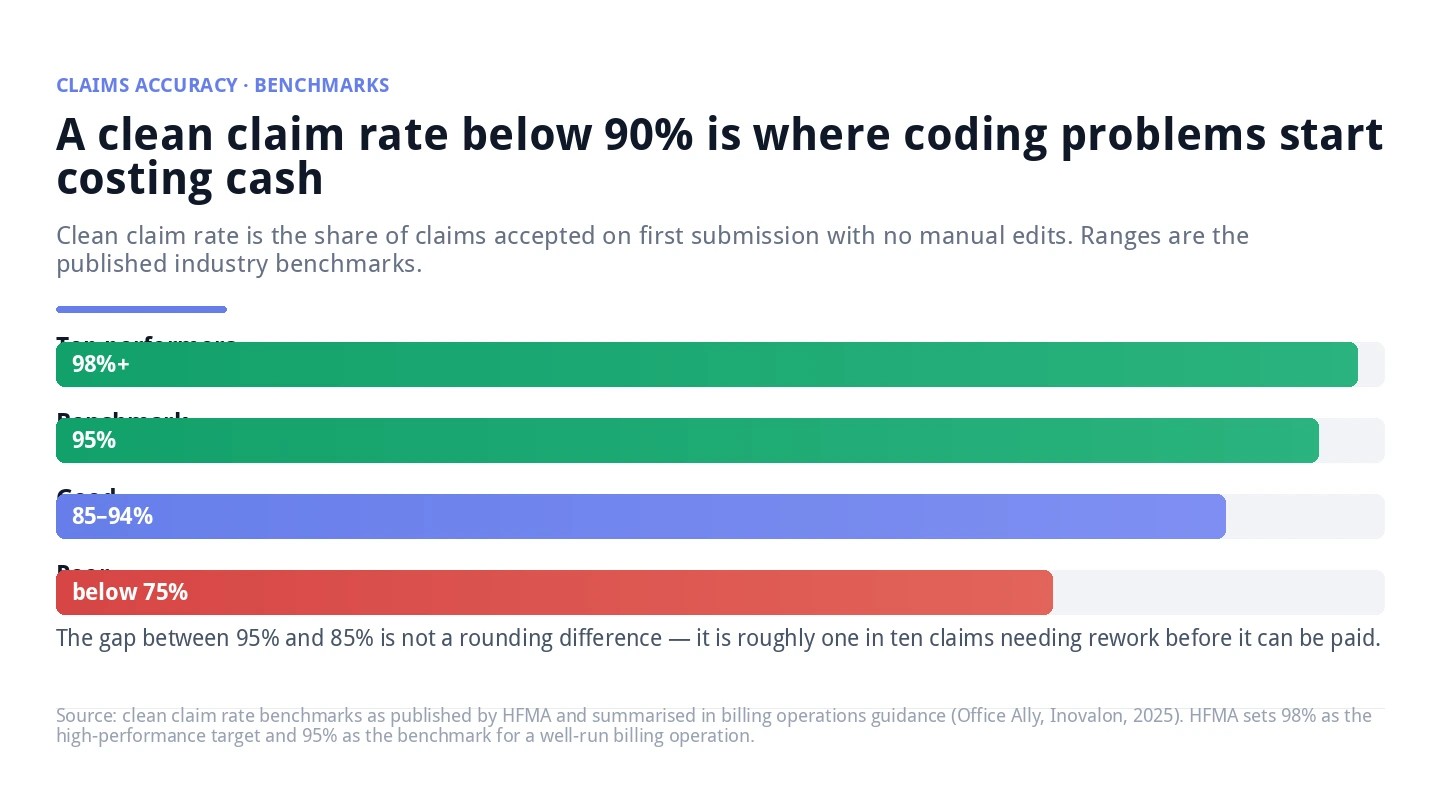
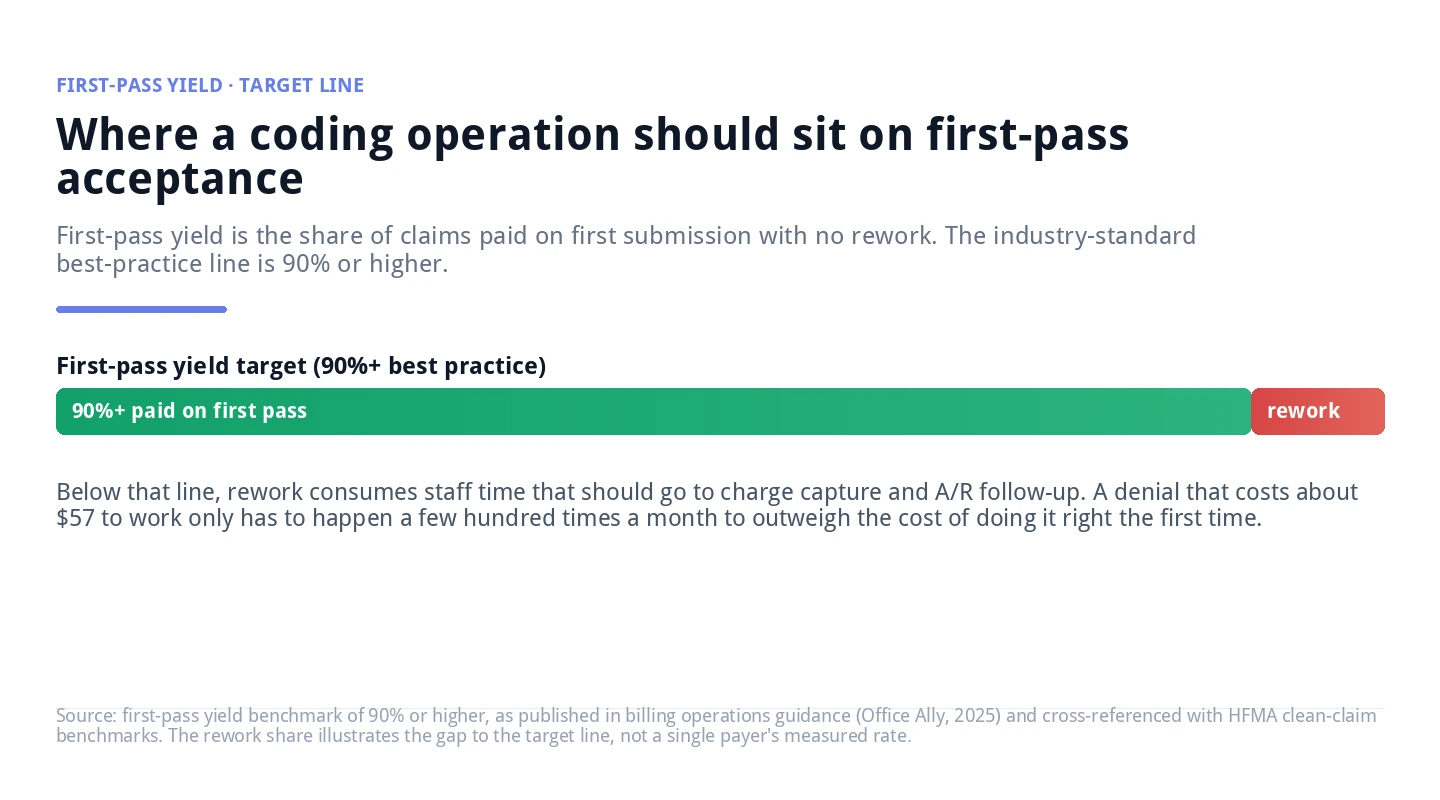 Figure 4. Where a coding operation should sit. First-pass yield is the share of claims paid on first submission with no rework; 90% or higher is the best-practice line. Source: billing operations guidance (Office Ally, 2025), cross-referenced with HFMA clean-claim benchmarks.
How to Choose Medical Coding Software for a Small Practice
Small practices should prioritize software that reduces rework without adding administrative overhead. Start by mapping your current workflow: who captures charges, who codes, who submits claims, and who works denials. The right tool should fit that workflow instead of forcing your team to rebuild it around the software.
Code set coverage: Confirm current ICD-10-CM, CPT, and HCPCS support, plus regular updates when code sets change.
Claim scrubbing: Look for edits that catch missing modifiers, invalid code combinations, and payer-specific issues before submission.
EHR and clearinghouse integration: Avoid double entry. Your coding tool should connect to documentation, eligibility, and claim submission systems.
Reporting: Track first-pass yield, denial reasons, and coding turnaround time so you can fix patterns, not just individual claims.
Support and training: A fast support team matters more than a long feature list when claims are stuck.
If you are comparing encoder-focused tools, see our guide on medical coding encoder software. For practices evaluating no-cost options, read free medical billing and coding software before committing to a platform.
Compliance, Security, and Implementation Tips
Medical coding software handles protected health information, so HIPAA compliance is non-negotiable. Verify role-based access, audit logs, encryption, and business associate agreement (BAA) terms before purchasing. The HHS HIPAA Security Rule provides a useful baseline for evaluating administrative, physical, and technical safeguards.
During implementation, run the new system in parallel with your existing process for a short period. Test common claim scenarios, validate payer rules, and confirm that denials and remittance data flow back into reporting. A clean rollout should also include coder training, documentation standards, and a clear escalation path when edits or payer rules are unclear.
For practices that need help beyond software, Dilijent Systems provides medical coding services, medical billing services, and denial management support to keep claims accurate after submission.
Common Mistakes to Avoid When Choosing Coding Software
Many practices choose coding software based on price or brand recognition alone. A better approach is to evaluate how the tool performs in your real workflow. Avoid these common mistakes:
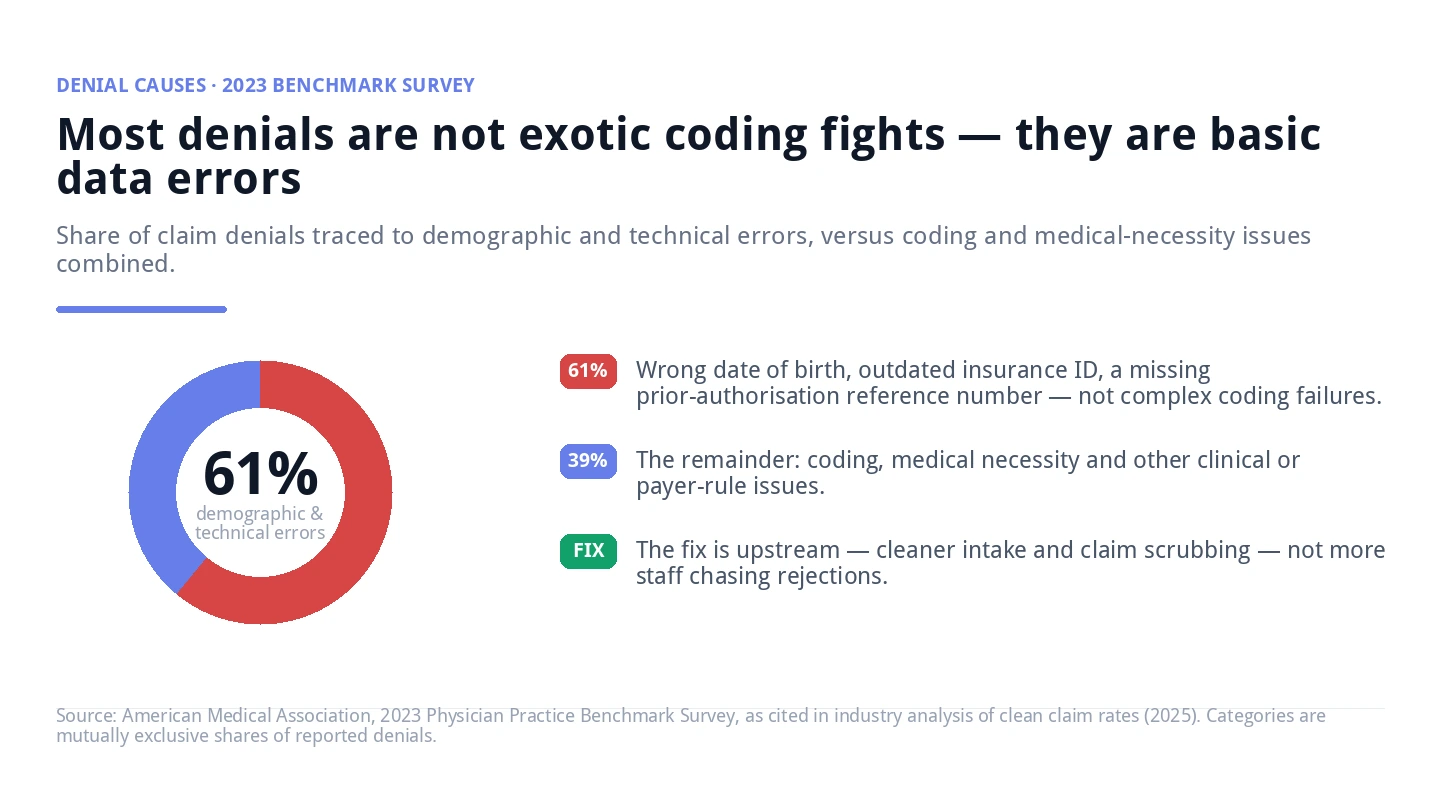
Ignoring payer-specific edits: A code can be valid but still denied by a payer. Make sure the software supports payer rules and claim-scrubbing edits.
Skipping integration checks: If the software does not connect cleanly with your EHR, practice management, or clearinghouse workflow, staff end up re-entering data and creating errors.
Not measuring outcomes: Track first-pass acceptance, denial rate, and coding turnaround time before and after implementation so you know whether the tool is improving performance.
Treating software as a replacement for expertise: Tools help coders work faster, but complex cases, audits, and payer appeals still require experienced coding and billing professionals.
Conclusion:
Medical coding software is essential in today’s healthcare industry. The top 10 solutions we’ve covered can help healthcare professionals simplify their coding processes, ensure accurate billing, and boost efficiency.
Frequently Asked Questions
What is the best medical coding software for small practices?
For small practices, cloud-based platforms with built-in ICD-10 and CPT coding assistance and billing integrations are usually the best fit. They keep costs predictable, need no local servers, and update their code sets automatically each year.
How much does medical coding software cost?
Pricing varies widely. Entry-level tools can start at a few hundred dollars per month, while full practice-management suites with coding, claims and reporting modules cost more per provider. Most vendors price per user or per claim volume.
Is coding software enough, or should I outsource medical coding?
Software speeds up coding but it does not certify accuracy or handle payer-specific edits. Many practices combine software with certified coders. Our medical coding services pair CPC and CCS certified coders with your existing system to keep claims clean and audit-ready.
What features should I look for in medical coding software?
Look for ICD-10, CPT and HCPCS code lookup, automated code suggestions, claim scrubbing, EHR and clearinghouse integrations, real-time eligibility checks, and reporting. Audit trails and HIPAA-compliant security are essential.
Is billing software the same as coding software?
No. Coding software assigns and validates ICD-10, CPT, and HCPCS codes. Billing software handles charge entry, claim submission, payment posting, and A/R. Many platforms bundle both, which is why the two get confused. Check whether a tool actually includes an encoder before you compare it.
Best Medical Encoder Software for Small Practices
The best encoder for a small practice is not the one with the longest feature list. It is the tool that keeps ICD-10, CPT and HCPCS rules current, flags unsupported code combinations, and fits the way your billers already work. Look for payer-specific edits, a clear audit trail and support that answers product questions quickly.
Best Software for Medical Coding and Billing
Coding software and billing software solve different problems. Coding software turns documentation into accurate codes; billing software turns those codes into clean claims and payments. The strongest setup connects both so a code change, payer rule or denial reason flows through the whole revenue cycle instead of being re-keyed in two systems.
Which Medical Coding Software Reduces Claim Denials Most Effectively?
Look for four capabilities: automated code checks before submission, real-time eligibility and authorization flags, payer-rule updates, and denial analytics that feed fixes back into the claim workflow. A tool that only reports denials after the fact will not reduce them on its own.
Our medical coding specialists can help you evaluate tools and, more importantly, make sure the workflow around them is sound.
Related guide: medical coding encoder software — types, code lookup and how small practices should compare tools.


